As fencing coaches (and fencers) we all learn fencing footwork from the very first session. Being able to move efficiently is a fundamental part of fencing. Up until recently I’ve taught fencing footwork in a standard way step – forward, step back, lunge, recover etc etc.
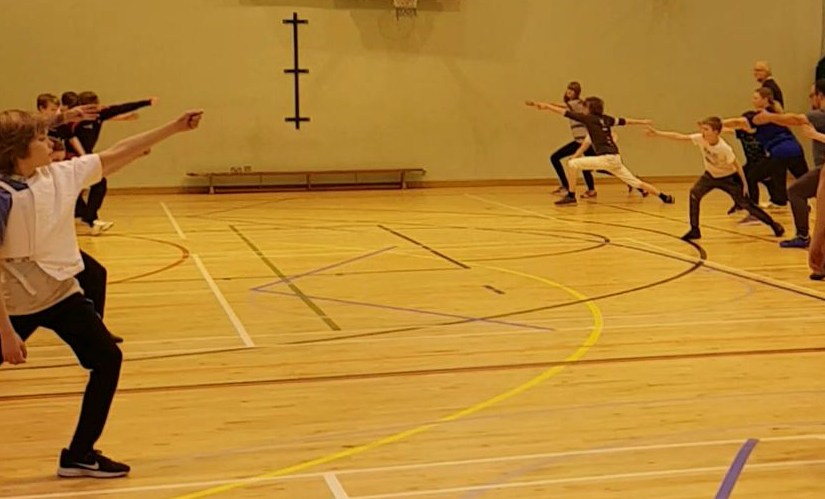
However, recently whilst working on my coach education I headed up to Salle Ossian where I was introduced to the concept of Rhythmic Footwork. It uses vocal rhythm and words with a certain amount of syllables to teach footwork to beginners. It’s also useful for running ANY footwork session.
The concept is as follows. Instead of saying things like – “step forward”, “step back” or “lunge” we use the words with the relevant amount of syllables for the movements. We use common words that are related to food but you can use whatever works for you or interests the beginners. As an example we use “Tea” for a step forward as it has a single syllable. We use cof-fee for two steps back. As you will see in the video below changing the rhythm of the word allows you to change the rhythm of the footwork.
We found that when we started using this system not only did it make footwork sessions more fun and kept beginners entertained for longer, but it allowed us to quickly teach complex footwork patterns in a fun way. The system really accelerated the learning of the fencing footwork. In a 20 minute session we could take a beginner from a simple step forward to a “Vezzali shuffle” (Pep-si-co-la) or even a combined group of footwork such as a “step, balestra, lunge” (tea-cake-juice). The most complex is “The Korean Hop”. This has 3 syllables so we use (Ba-Na-Na).
Overall the benefits were as follows:
Accelerated learning of complex footwork patterns.
More entertaining than standard footwork teaching.
Allows the coach to control and vary the rhythm of the footwork.
Makes it easy to play games like Simon Says.
Beginners remember the footwork names better as they are related to words they know.
It is simple to combine words together – tea, cake, juice.
It provides the opportunity for chunking, to be used as part of other movement patterns. (So tea, cake, juice may be shortened to “Triangle” for example).
It gave the beginners and kids their own language that could be used to pass on the footwork easily.
I have implemented this at both West Lothian Fencing Club and at Heriot-Watt University and the results have been amazing.
Below is a video featuring Ben Schuessler giving examples of Rhythmic (Coca-Cola) footwork in practice. Thanks to Coach Phil Carson for the intro to this.
Feel freee to leave a comment and tell me what you think. Also, I have a Youtube channel with coaching content that is updated often. Please do subscribe if this sort of content interests you!
West Lothian Fencing Club opened its doors in Feb 2018 and has just passed its second anniversary. It’s a Fencing club built entirely on volunteers who take no fee for coaching or running the club. This allows the club to be one of the lowest cost clubs in Scotland (£15 pcm for 8 sessions). West Lothian Fencing Club is based in Bathgate near Livingston in the heart of West Lothian.
The club is designed to work as a community with many of our members family groups of both parents and children. Many of our fencers are also veterans and due to the fact that we do not separate sessions we have a higher percentage of parents including mums in the group who can join in with the kids. (Some of them now call themselves “The Sabre Moms”).
After a major shake-up at the club last year, the committee and Head Coach decided to create a strategy for controlled growth and to increase the numbers of members competing at national and international competitions.
So what was the plan
Increase the amount of fencers competing at the club.
Strengthen the club identity.
Strengthen the integration with other clubs.
Undertake fund raising to fund improvements at the club
Improve the level of fencing and coaching at the club.
Further engage the community.
Use technology to reduce costs and allow us to train more intelligently.
So how did we do all of this and what happened?
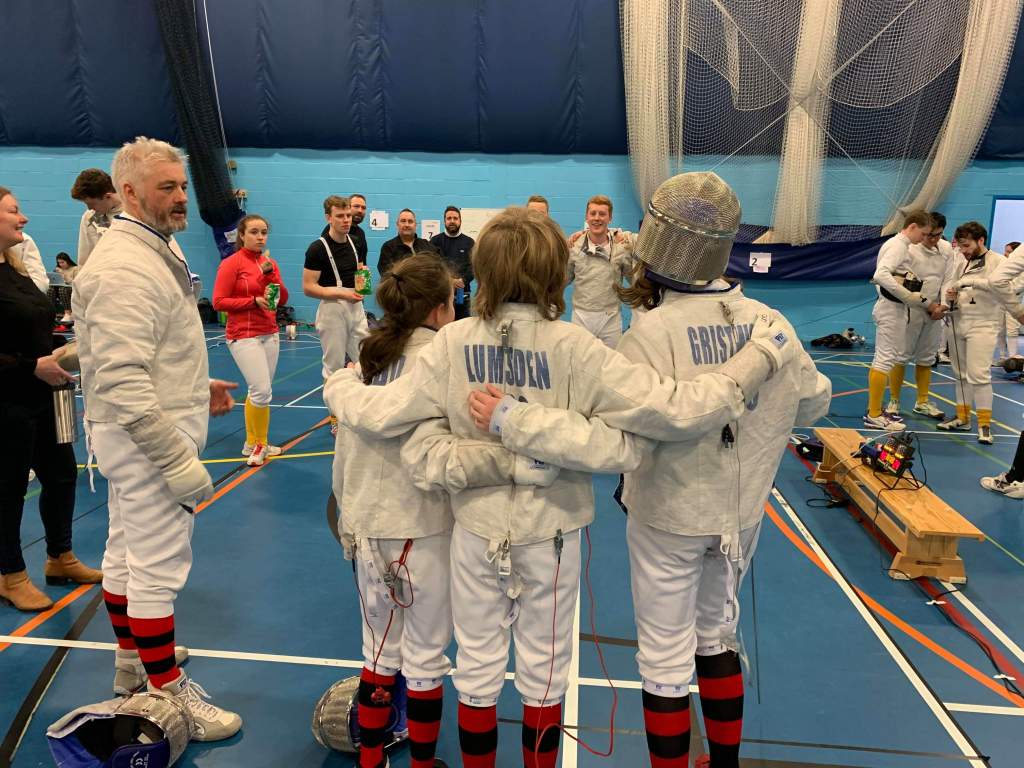
The plan was to choose 4 young role models who we felt would represent the club well and put in the necessary work and training required to compete. With the help of West Lothian Council we were able to get the necessary kit, create a training program that would accelerate their learning (we all know 4 hours is not really enough per week). Games, HIIT and Strength and conditioning programs were created that could be delivered remotely if required with the help of the parents who have themselves become incredibly engaged. We also enrolled the fencers on the Scottish Fencing Pathway, so they could gain extra experience, integrate and make friends with fencers at other clubs, which has worked well. The pinnacle of the year was to be competing at the Challenge Wratislavia competition in Poland. (Sadly Corona Virus put an end to that for this year).
At the same time we improved the coaching at the club and working closely with Phil Carson at Salle Ossian and Stan Stoodley we looked at the latest techniques for accelerated learning. Those techniques were then broken down further to create small individual games that could also be practiced at home with the parents. (More on that in a later blog post)
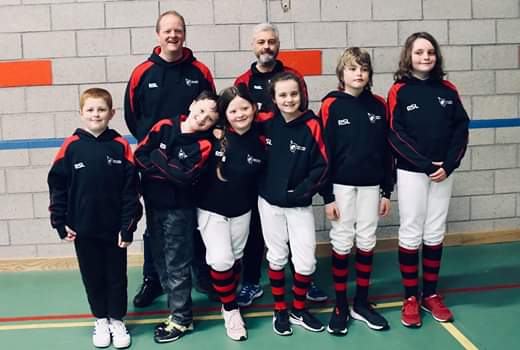
The kids wore the clubs black and red tracksuit at competition but we also took the decision to purchase red and black hooped socks so we had a unique identity on the piste. We were noticeable at competitions and we could also easily find and support each other. This instilled a real pride in the club colours and within a few months all of the children in the club had the distinctive socks and hoodies with their name on the back.
The Kids in their club kit
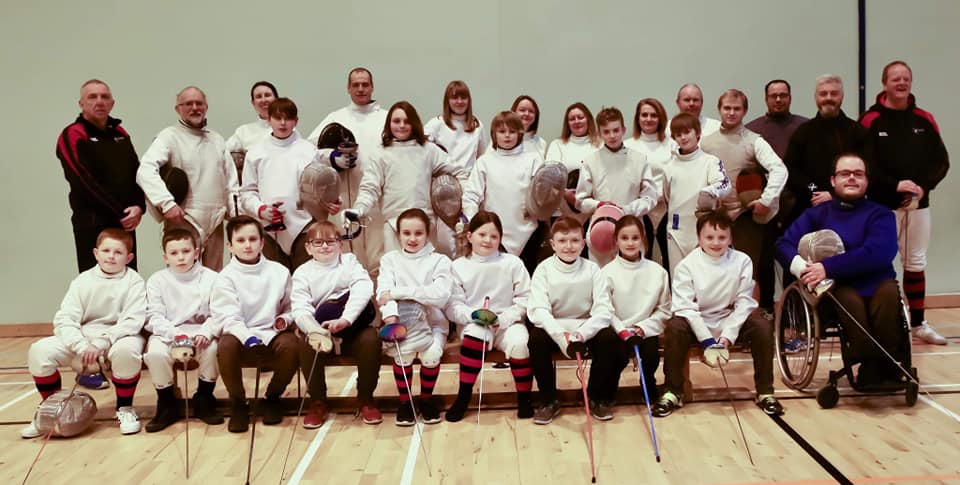
We continued to increase the opportunity for training by adding 3 weapon training days to our schedule. These have been very successful again due to our low costs we offer these for at a suggested donation of £10 for the whole day. As they are not for profit we have been able to pull in help from other coaches and for 30 fencers at the last session we had a level 4, two level 3s and two level 2 coaches in attendance as well as fencers from around Scotland. Further individual lessons were also organised outside club sessions.
As there are also strong links with Heriot-Watt University it has also been possible for the members to train at the University Club (where I am also Head Coach). This is in part also due to the Heriot-Watt Fencing Club committee and current President Ben Schuessler who could see the benefits on all sides and worked to allow this to happen. We are also forging strong links with Salle Ossian ones of Britains best Sabre clubs up in Perth and have trained there too – the plan is for more training next season.
In Scotland we are lucky to have David Barbour and the other volunteers who run the Foundation for Scottish Fencing and the Youth Development Series of competitions. These are excellent competitions to get under 15s into competition, and to be honest, without them it would be far more difficult to get a good start in competitive fencing.
So in summary, what happened this year?
West Lothian Fencing Club strengthened its presence and identity within the Scottish Fencing circuit.
We have an incredibly strong committee who know what they are doing and make sensible informed decisions. This has allowed us to make decisions on fund-raising and pushing the club forward.
We are a SwordMark club.
We have a diverse membership.
We increased the amount of juniors in the club competing from 0-13 in one year.
We increased the club membership by 25% and retained almost all of our members in the last year.
Almost every fencer now has their own kit reducing the burden on transport and storage for the coaches.
Club members wear their named hoodies and socks with pride. (Including the adults)
The engagement from the adults and children in relation to training has been incredible. Some of the juniors are putting in a total of 20 hours per week and training with their parents. The Parents and Junior fencers have also looked to help with coaching and came and supported the Heriot-Watt University Students during BUCS events.
We have LEARNED A LOT about what works and what doesn’t and how we can accelerate our learning for both the fencers and coaches.
We have formed strong bonds with Heriot-Watt and are looking to further strengthen links with Salle Ossian.
Our fencers fenced in all weapons across all age groups this year. Our Juniors are now performing well and winning medals. (Still a lot to learn; we can’t wait!)
We had 3 teams at the Stirling Sword event and will likely have more next year.
Our adults and Veterans fencers are entering development and open competition.
Four of our Juniors are members of the Scotland Pathway Squad.
Two of our Veterans made the Scottish team for the Home Nations International match (again, sadly cancelled due to Corona Virus).
The club has actually reduced its cost to members and simplified its membership structure as well as giving family discounts!
Most importantly, we are building a strong, friendly, and supportive community who are having fun, working hard and getting fit!
Of course the club is always open to new members! The first two sessions are free, kit is provided and beginners are welcome! Friday night 7pm at Bathgate Academy and Tuesday night at St.Kents in Blackburn.
 Coach Kev's Fencing Blog