Fencing and Coaching During the Coronavirus Lockdown.

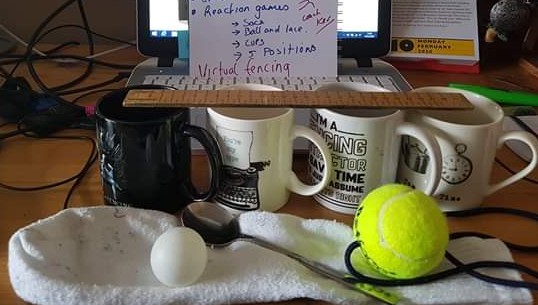
Some of the items that are useful for running fencing sessions

Introduction

Most of us are currently in lockdown due to Coronavirus. This has left many Fencing clubs scrambling to provide some level of service whilst social distancing is implemented.

At this time there are lots of on-line resources for Strength & Conditioning and Fitness. This is fine, but we felt it was important to provide Fencing related activities beyond the usual warm-up, fitness regime and footwork practice.

Here are some ways we have found of keeping folks training and entertained. Hopefully they will be of use!

Using Tech and Online Resources

It seems that almost everyone has managed to get on-line whether it is through Facebook Live, Zoom or YouTube content. In my opinion there is no point in “reinventing the wheel” when it comes to online fitness or Yoga sessions and use of these specific resources should be encouraged as an addition to the fencing specific sessions. As an example in the UK Joe Wicks and his “PE with Joe” has proved very popular for H.I.I.T type fitness.

A multitude of training resources exist online that are relevant to both fencing (or combat sports) and fitness in general. Many of these also provide options which allow you to work in the limited space many homes have.

One of my favourite channels is by Luka Hocevar. This channel provides fun exercises. One of his many videos is below.

A selection of cardio exercises that can be done at home.

When it comes to our Fencing sessions and 1-1 lessons we use Zoom. The sessions have been reduced to 1 hour slots. We also use Social Media such as Facebook, Instagram and YouTube for distributing club information. This can include session updates, challenges and other fun ideas to try at home.

How to Manage Limited Space

Fencing usually requires large areas such as Gymnasiums and that fencers meet at a club to participate. So how do we make it possible to provide a service with maximum participation that is fun, relevant and beneficial?

At our club we have developed all of our training to work within the length of a Yoga Mat.

Making Use of Household Items

It’s important to ensure that as many people take part as possible. Not everyone has an agility ladder, hurdles, or cones lying about.

We use items in our training sessions that almost every household has (or can quickly buy). The list is not exhaustive but some ideas include:

  1. A tennis ball can be used for a multitude of games requiring co-ordination, balance, accuracy and timing.
  2. A length of tape is used to mark the area of play.
  3. Cups or toilet rolls can be used instead cones for fitness exercises and games requiring speed and agility.
  4. A sock or glove can be used for games requiring speed, reactions balance and timing.
  5. A shoe lace or other cable can be laid on the floor to mark the participation area and used for games requiring distance and timing.
  6. A spoon can be used with a tennis ball for balance games involving footwork.
  7. A ruler can represent a fencing sword but can also be used for hand-eye co-ordination games.
  8. Stairs are excellent for cardio exercises.
  9. Small Steps or home made practice targets are a great idea for practicing accuracy and technique.
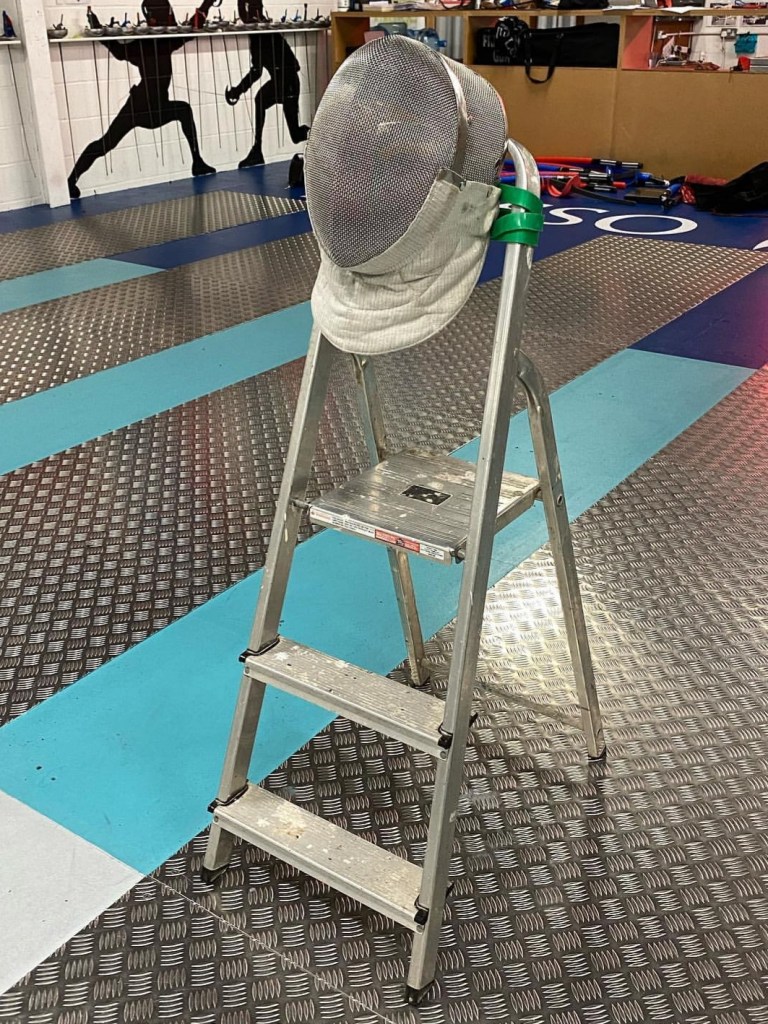
An example of simple fencing dummy. (Thanks to Phil Carson)

If you are technical and looking for a more in-depth project then why not have a look at something like this one developed by our club armourer.

Our Club Training Sessions

First of all – West Lothian Fencing Club were aware that not all clubs or fencers would be ina position to train. So the club opened up its sessions to any fencer for free who wanted to attend. This meant we had fencers from all over the UK, America and Germany attending. We wanted to make sure no-one missed out!

Before lockdown our club sessions would start off with a warm-up, followed by Rhythmic Footwork. Fencing-related relay races based around the agility ladder would come next,with games, and finally lessons or free sparring.

To save space and for safety reasons we don’t use fencing weapons during our online sessions. Here is what we do instead:

  1. Warm-up has more ‘on-the-spot’ exercises and stretches.
  2. Rhythmic footwork places more emphasis on shorter movements forward and back within the assigned space.
  3. Relay races make heavy use of agility ladder patterns executed in the defined space with greater repetitions forth and back.
  4. Games are redesigned to take place in the smaller space. These emphasise co-ordination, timing, accuracy, speed and fun!
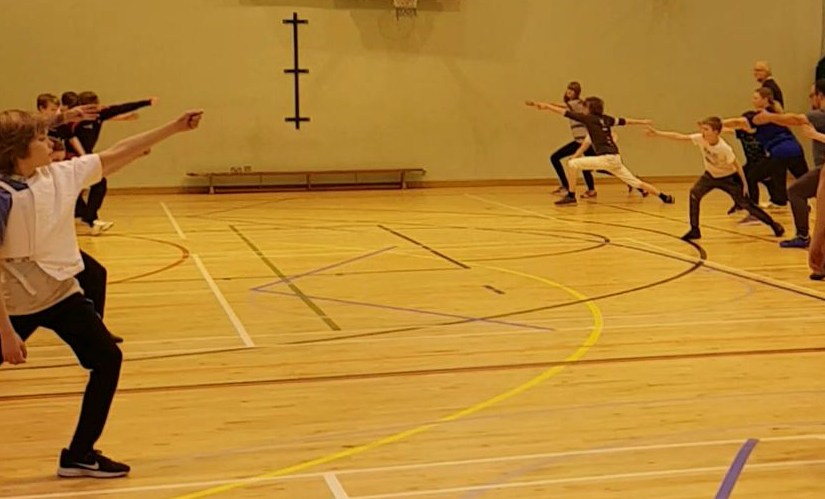
  5. Shadow Fencing is led by the coach through visual cues that indicate attack or defence.
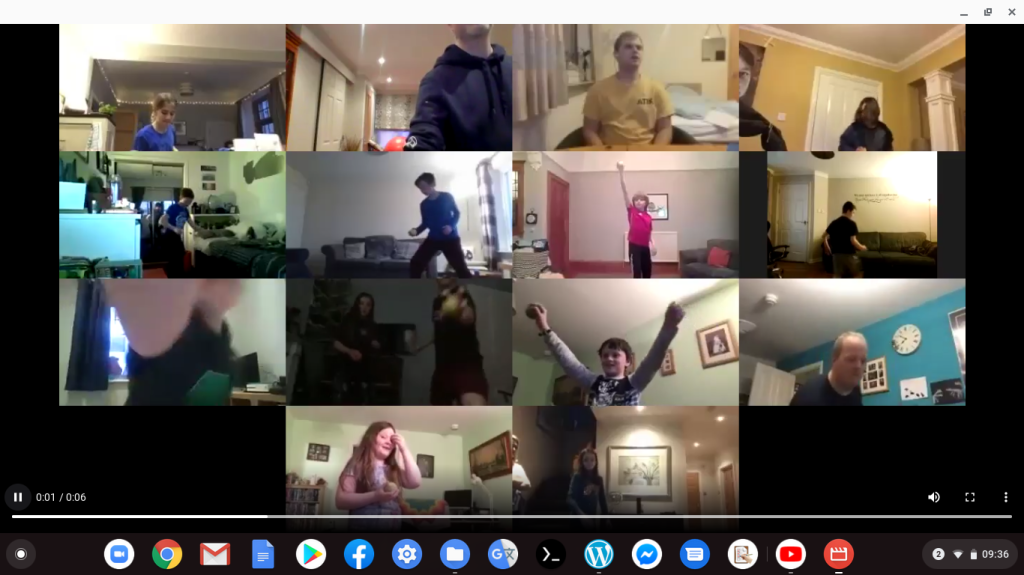
The Zoom Fencing session

Online Fencing lessons

While we can’t give traditional 1-1 Fencing lessons during lockdown our online lessons make use of a target or fencing dummy (or rope in the parents :)).

We are lucky in that many of our young Fencers have a parent who participates at the club. This has allowed us to ‘outsource’ the lessons in general with a high level of guidance.

  1. Ideally the lesson should be a game that both ‘Parent Coach’ and ‘Student’ can play equally.
  2. Be very specific about the context of the coaching movements.
  3. Reduce the amount of actions and outcomes to practice per session.
  4. Build up the constraints and coaching over a longer period of time.
  5. Ensure the lessons are not just drills but include options to make the student think.
  6. Record the sessions so progress can be monitored and mistakes or misunderstandings rectified.
  7. If a parent or sibling is not available actions can be practiced on a dummy or target.
  8. Use online resources that already exist to solidify the understanding. This can be an example of a tactic or hit being executed.
  9. Time can also be spent undertaking video analysis taken from the fencers previous bouts.
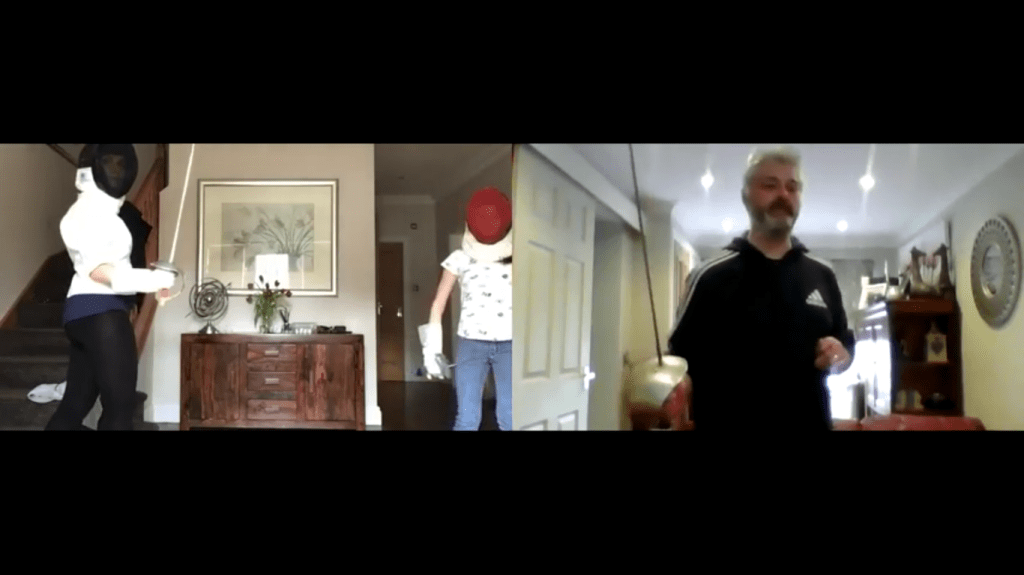
An online fencing lesson taking place over Zoom.

Issuing Weekly Challenges

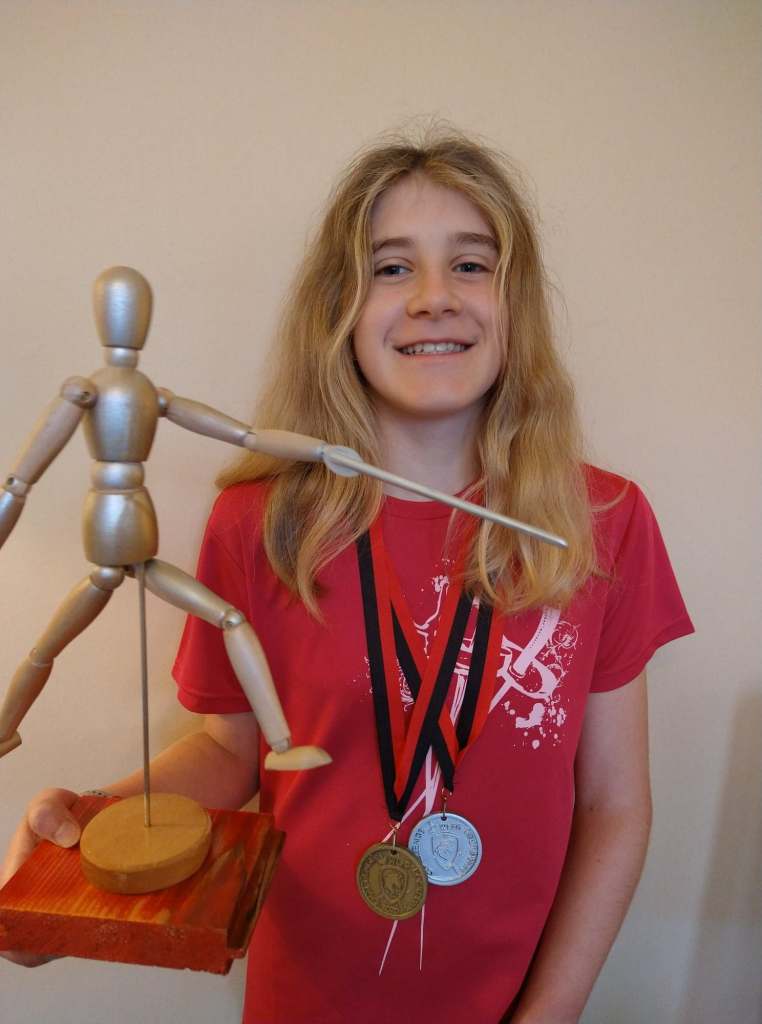
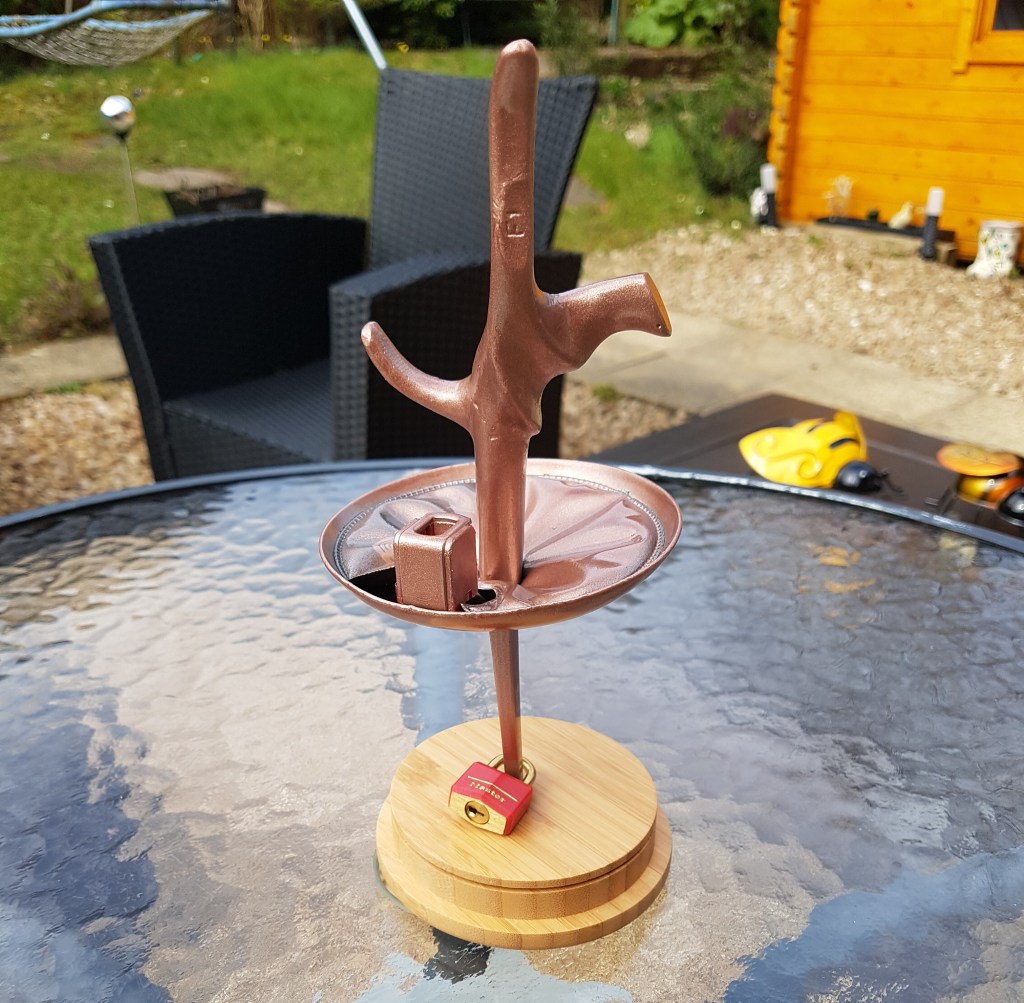
To keep the competition going and the spirits of the club members up we have announced weekly challenges. At week 5 the overall winner will win our Lockdown Trophy, with medals being won for each of the individual challenges, too.

The challenges are varied, relevant of course to fencing and use standard housedold items. They span five weeks and allow members time to practice and work on their weaknesses in order to win the challenge. Of course they have to recognise what their weakness is!

To ensure fairness, attempts must be recorded and the video sent to myself as head coach to keep score:

Here’s our schedule:

  1. Week 1 – Speed, fitness and efficiency of movement.
  2. Week 2 – Accuracy and timing.
  3. Week 3 – Hand and Eye Co-ordination.
  4. Week 4 – Balance
  5. Week 5 – Accuracy, Hand and Eye Co-ordination
  6. Week 6 – Learn to Juggle – Special Trophy for anyone going from 0-1 min+ in two weeks.

The challenges are varied and demonstrate the benefit of practice and working on weaknesses. This means anyone with the right strategy will have the opportunity to win. None of them were based on strength and physical capability alone.
Hopefully this blog post has given you some ideas on what you can do to run your club online, with limited space and household resources during the lockdown. Let us know if it has been of use to you! And share your ideas with us!

For further information have a look at my YouTube Channel – Fencing Coach Kev or indeed read some of my other blog posts!

A link to our a 1 minute teaser session is below!

Also check out the West Lothian Fencing Club and Heriot-Watt Fencing Club websites!
H.I.I.T for Fencing: Keeping fit in a small space with limited time!

It seems appropriate at this time when many of us are in lockdown to try and increase or maintain our fitness levels. A few years ago I was looking into the best way to do this at home. Tabata or H.I.I.T was suggested and trying these exercises worked (and still works) for me.

The Histoty of Tabata

High Intenstity Interval Training or Tabata training was discovered by Japanese scientist Dr. Izumi Tabata and a team of researchers from the National Institute of Fitness and Sports in Tokyo.

Research was conducted on two groups of athletes. The first group trained at a moderate intensity level while the second group trained at a high-intensity level. The moderate intensity group worked out five days a week for a total of six weeks; each workout lasting for one hour. The high-intensity group worked out four days a week for six weeks; each workout lasted four minutes and 20 seconds (with 10 seconds of rest in between each set).

The results were conclusive; Group 1 had increased their aerobic system (cardiovascular), but showed little or no results for their anaerobic system (muscle). Group 2 showed much more increase in their aerobic system than Group 1, and increased their anaerobic system by 28 percent!

In conclusion, high-intensity interval training had more impact on strength and conditioning.

How does H.I.I.T work?

Each exercise in a given workout lasts only three minutes, but it’s likely to be one of the longest three minutes you’ve ever endured. The structure of the program is as follows:

  • Work out hard for 20 seconds
  • Rest for 10 seconds
  • Complete 3 rounds

You push yourself as hard as you can for 20 seconds and rest for 10 seconds. This is one set. You’ll complete 3 sets. You can of course do more or less depending on your fitness levels. 

H.I.I.T for fencing

The benefits of H.I.I.T for fencing are as follows:

  • Works both cardio and strength.
  • Takes almost no space.
  • Takes very little time.
  • The H.I.I.T exercises shown in the video work all body aspects.
  • You start off at your own level.
  • The sets and timing (3 mins) represent both rest and recovery periods in a bout.
  • It can be done with no equipment.

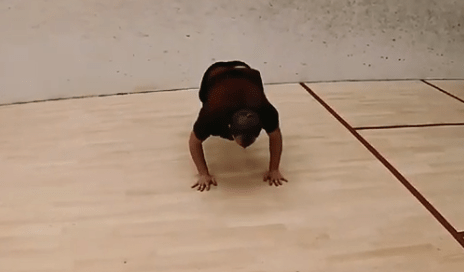
You can do pretty much any exercise you wish. You can do squats, push-ups, burpees or any other exercise that works your large muscle groups. If you have more time and space you can combine them with agility ladder workouts or kettlebells.

H.I.I.T is great to get a quick workout if you’re short on time and you want to improve endurance and speed. It’s ideal when you can’t get to the gym!

Have a look at the video below. Leave comments and of course feel free to also subscribe to my YouTube channel “Learntofence”.

Using rhythm and syllables to teach fencing footwork – Coca-Cola Footwork.

As fencing coaches (and fencers) we all learn fencing footwork from the very first session. Being able to move efficiently is a fundamental part of fencing. Up until recently I’ve taught fencing footwork in a standard way step – forward, step back, lunge, recover etc etc.

However, recently whilst working on my coach education I headed up to Salle Ossian where I was introduced to the concept of Rhythmic Footwork. It uses vocal rhythm and words with a certain amount of syllables to teach footwork to beginners. It’s also useful for running ANY footwork session.

The concept is as follows. Instead of saying things like – “step forward”, “step back” or “lunge” we use the words with the relevant amount of syllables for the movements. We use common words that are related to food but you can use whatever works for you or interests the beginners. As an example we use “Tea” for a step forward as it has a single syllable. We use cof-fee for two steps back. As you will see in the video below changing the rhythm of the word allows you to change the rhythm of the footwork.

We found that when we started using this system not only did it make footwork sessions more fun and kept beginners entertained for longer, but it allowed us to quickly teach complex footwork patterns in a fun way. The system really accelerated the learning of the fencing footwork. In a 20 minute session we could take a beginner from a simple step forward to a “Vezzali shuffle” (Pep-si-co-la) or even a combined group of footwork such as a “step, balestra, lunge” (tea-cake-juice). The most complex is “The Korean Hop”. This has 3 syllables so we use (Ba-Na-Na).

Overall the benefits were as follows:

  • Accelerated learning of complex footwork patterns.
  • More entertaining than standard footwork teaching.
  • Allows the coach to control and vary the rhythm of the footwork.
  • Makes it easy to play games like Simon Says.
  • Beginners remember the footwork names better as they are related to words they know.
  • It is simple to combine words together – tea, cake, juice.
  • It provides the opportunity for chunking, to be used as part of other movement patterns. (So tea, cake, juice may be shortened to “Triangle” for example).
  • It gave the beginners and kids their own language that could be used to pass on the footwork easily.

I have implemented this at both West Lothian Fencing Club and at Heriot-Watt University and the results have been amazing.

Below is a video featuring Ben Schuessler giving examples of Rhythmic (Coca-Cola) footwork in practice. Thanks to Coach Phil Carson for the intro to this.

Feel freee to leave a comment and tell me what you think. Also, I have a Youtube channel with coaching content that is updated often. Please do subscribe if this sort of content interests you!

https://www.youtube.com/channel/UCyfC9gZWzY_Vaf9dXrXcJqg

West Lothian Fencing Club – A year of growth.

West Lothian Fencing Club opened its doors in Feb 2018 and has just passed its second anniversary. It’s a Fencing club built entirely on volunteers who take no fee for coaching or running the club. This allows the club to be one of the lowest cost clubs in Scotland (£15 pcm for 8 sessions). West Lothian Fencing Club is based in Bathgate near Livingston in the heart of West Lothian.

The club is designed to work as a community with many of our members family groups of both parents and children. Many of our fencers are also veterans and due to the fact that we do not separate sessions we have a higher percentage of parents including mums in the group who can join in with the kids. (Some of them now call themselves “The Sabre Moms”).

After a major shake-up at the club last year, the committee and Head Coach decided to create a strategy for controlled growth and to increase the numbers of members competing at national and international competitions.

So what was the plan

  • Increase the amount of fencers competing at the club.
  • Strengthen the club identity.
  • Strengthen the integration with other clubs.
  • Undertake fund raising to fund improvements at the club
  • Improve the level of fencing and coaching at the club.
  • Further engage the community.
  • Use technology to reduce costs and allow us to train more intelligently.

So how did we do all of this and what happened?

The plan was to choose 4 young role models who we felt would represent the club well and put in the necessary work and training required to compete. With the help of West Lothian Council we were able to get the necessary kit, create a training program that would accelerate their learning (we all know 4 hours is not really enough per week). Games, HIIT and Strength and conditioning programs were created that could be delivered remotely if required with the help of the parents who have themselves become incredibly engaged. We also enrolled the fencers on the Scottish Fencing Pathway, so they could gain extra experience, integrate and make friends with fencers at other clubs, which has worked well. The pinnacle of the year was to be competing at the Challenge Wratislavia competition in Poland. (Sadly Corona Virus put an end to that for this year).

At the same time we improved the coaching at the club and working closely with Phil Carson at Salle Ossian and Stan Stoodley we looked at the latest techniques for accelerated learning. Those techniques were then broken down further to create small individual games that could also be practiced at home with the parents. (More on that in a later blog post)

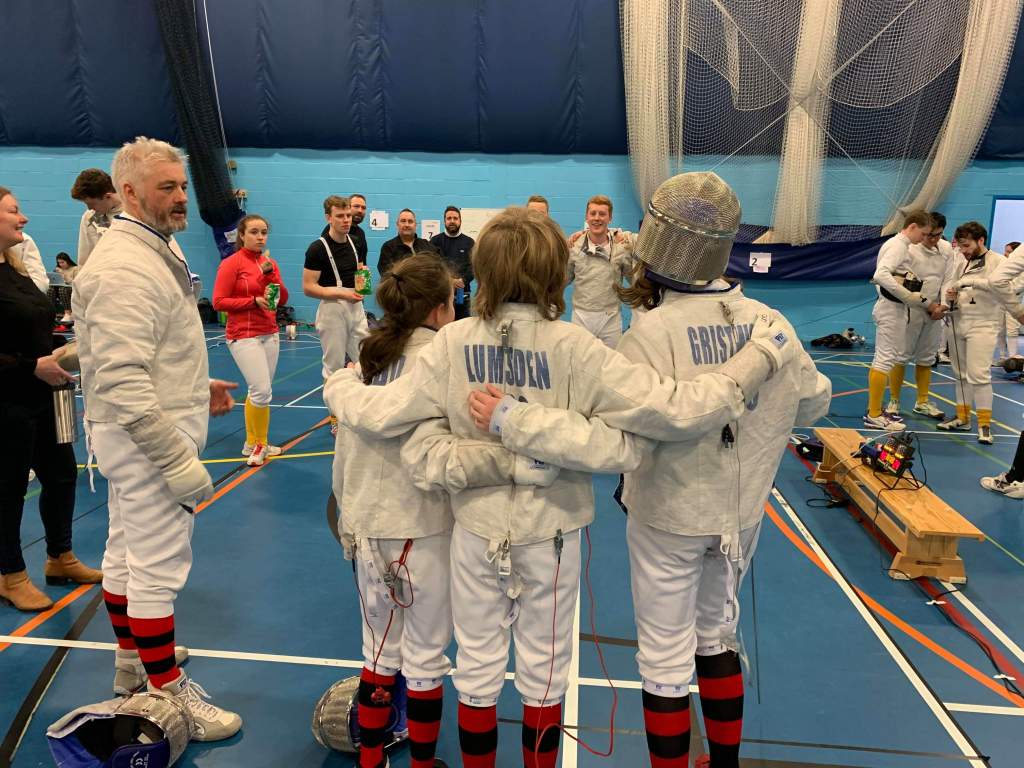
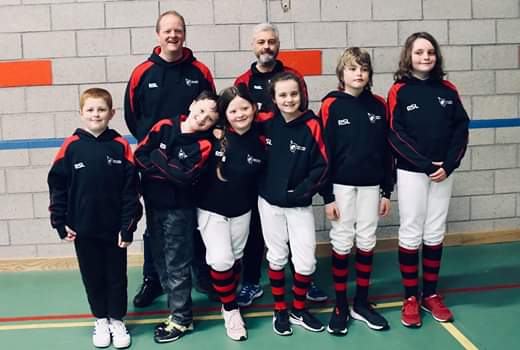
The kids wore the clubs black and red tracksuit at competition but we also took the decision to purchase red and black hooped socks so we had a unique identity on the piste. We were noticeable at competitions and we could also easily find and support each other. This instilled a real pride in the club colours and within a few months all of the children in the club had the distinctive socks and hoodies with their name on the back.

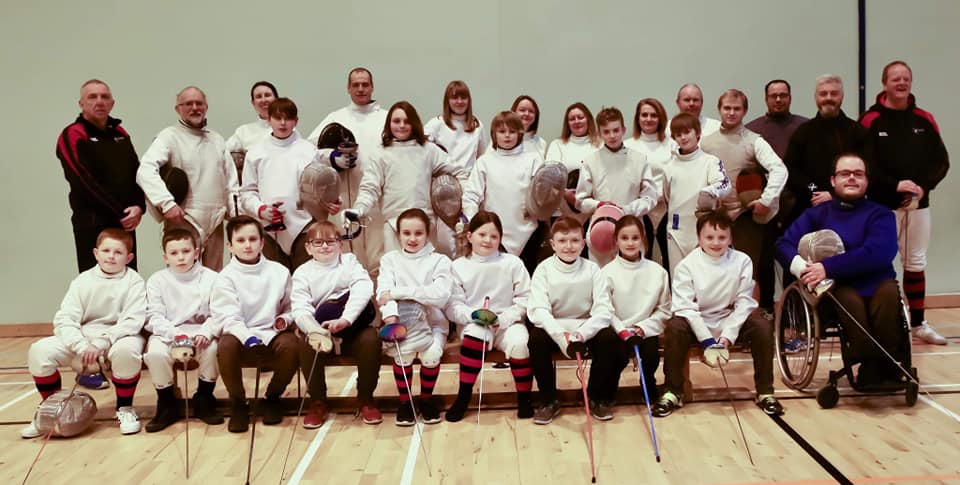
The Kids in their club kit

We continued to increase the opportunity for training by adding 3 weapon training days to our schedule. These have been very successful again due to our low costs we offer these for at a suggested donation of £10 for the whole day. As they are not for profit we have been able to pull in help from other coaches and for 30 fencers at the last session we had a level 4, two level 3s and two level 2 coaches in attendance as well as fencers from around Scotland. Further individual lessons were also organised outside club sessions.

As there are also strong links with Heriot-Watt University it has also been possible for the members to train at the University Club (where I am also Head Coach). This is in part also due to the Heriot-Watt Fencing Club committee and current President Ben Schuessler who could see the benefits on all sides and worked to allow this to happen. We are also forging strong links with Salle Ossian ones of Britains best Sabre clubs up in Perth and have trained there too – the plan is for more training next season.

In Scotland we are lucky to have David Barbour and the other volunteers who run the Foundation for Scottish Fencing and the Youth Development Series of competitions. These are excellent competitions to get under 15s into competition, and to be honest, without them it would be far more difficult to get a good start in competitive fencing.

So in summary, what happened this year?

  • West Lothian Fencing Club strengthened its presence and identity within the Scottish Fencing circuit.
  • We have an incredibly strong committee who know what they are doing and make sensible informed decisions. This has allowed us to make decisions on fund-raising and pushing the club forward.
  • We are a SwordMark club.
  • We have a diverse membership.
  • We increased the amount of juniors in the club competing from 0-13 in one year.
  • We increased the club membership by 25% and retained almost all of our members in the last year.
  • Almost every fencer now has their own kit reducing the burden on transport and storage for the coaches.
  • Club members wear their named hoodies and socks with pride. (Including the adults)
  • The engagement from the adults and children in relation to training has been incredible. Some of the juniors are putting in a total of 20 hours per week and training with their parents. The Parents and Junior fencers have also looked to help with coaching and came and supported the Heriot-Watt University Students during BUCS events.
  • We have LEARNED A LOT about what works and what doesn’t and how we can accelerate our learning for both the fencers and coaches.
  • We have formed strong bonds with Heriot-Watt and are looking to further strengthen links with Salle Ossian.
  • Our fencers fenced in all weapons across all age groups this year. Our Juniors are now performing well and winning medals. (Still a lot to learn; we can’t wait!)
  • We had 3 teams at the Stirling Sword event and will likely have more next year.
  • Our adults and Veterans fencers are entering development and open competition.
  • Four of our Juniors are members of the Scotland Pathway Squad.
  • Two of our Veterans made the Scottish team for the Home Nations International match (again, sadly cancelled due to Corona Virus).
  • The club has actually reduced its cost to members and simplified its membership structure as well as giving family discounts!
  • Most importantly, we are building a strong, friendly, and supportive community who are having fun, working hard and getting fit!

Of course the club is always open to new members! The first two sessions are free, kit is provided and beginners are welcome! Friday night 7pm at Bathgate Academy and Tuesday night at St.Kents in Blackburn.